
The Bio Governance Scorecard
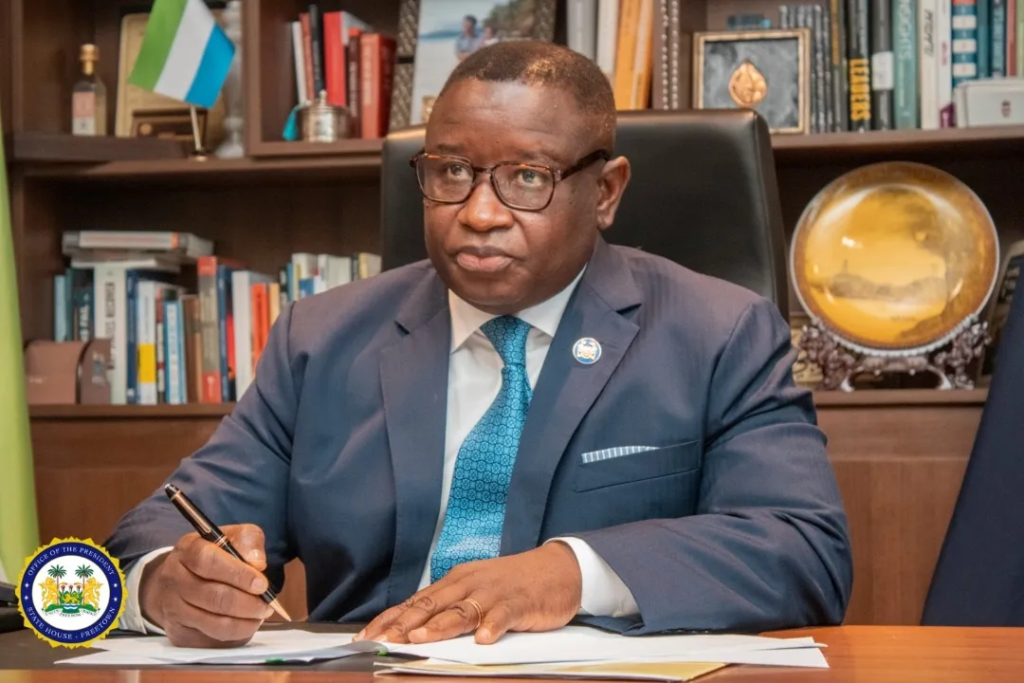
When Julius Maada Bio was elected President of Sierra Leone in April 2018 with 51.8% of the vote, he inherited a country still defined internationally by its 11-year civil war, the 2014 Ebola crisis, and decades of governance fragility. Eight years later, the country holds the ECOWAS chairmanship, a near-unanimous UN Security Council seat, a GPE Champion designation, and a string of continental and global governance awards. This research piece maps that transformation systematically — building the empirical case for what principled, sustained, people-centred leadership can accomplish.
The Education Transformation
In his first month in office, Bio became the first Sierra Leonean president to introduce free education through executive order for primary and secondary school students in public schools throughout Sierra Leone.That executive order became the Free Quality School Education Programme and its results, confirmed by the Global Partnership for Education’s March 2026 Champion announcement, are among the most significant human capital outcomes on the continent in a decade: nearly 50% enrolment increase, one million new learners, 800,000 pupils fed in school daily, and education spending sustained above 20% of the national budget through a pandemic and a debt crisis.
The Governance and Transparency Record
The Anti-Corruption Commission’s 2024 Annual Report, presented for the seventh consecutive year as mandated by the Anti-Corruption Act of 2002, highlighted notable progress in investigations, prosecutions, strategic partnerships, and institutional reforms throughout 2024. President Bio received it with a direct message to the ACC: “You have made corruption in Sierra Leone not only unfashionable but also risky and dangerous.” In February 2025, Sierra Leone received the 2023 Right to Access Information Annual Report — with the Commission Chair commending President Bio for “creating an enabling environment for free speech and access to information.”
The Gender Leadership Awards
President Bio was honoured with two prestigious continental awards — the African HeForShe Champion of the Year Award 2024 and the Presidential African Intelligence Award 2024 in recognition of his transformative leadership and commitment to advancing gender equality, girl-child education, and human capital development. The awards were presented by former Malawi President Dr. Joyce Banda. In his acceptance remarks, President Bio affirmed that “these awards are not just personal achievements but a testament to the collective efforts of my government and the people of Sierra Leone in fostering education, gender equality, and women’s empowerment.”
The Youth Investment
In July 2025, President Bio received the first-ever comprehensive Status of Youth Report in Sierra Leone’s history — described by the Ministry of Youth Affairs as “a landmark achievement made possible under your leadership, and a model that others in the region can emulate.” The data-driven report outlines the realities facing Sierra Leone’s youth and sets strategic recommendations for a National Youth Wealth Creation Programme — built on the foundation of the 500,000 jobs targeted under the Medium-Term National Development Plan 2024–2030.
The International Credibility Arc
Bio ran on a five-pillar platform focused on transforming the country’s economy, human development, improving governance, infrastructure, and overhauling financing of the public sector. The newly appointed CEO of the African Peer Review Mechanism, Ambassador Marie Antoinette Rose Quatre, commended President Bio for his “visionary leadership and steadfast commitment to governance” during a visit to State House in May 2025. In September 2025, President Bio highlighted significant progress achieved under his leadership across multiple sectors education, health, infrastructure, good governance, and the empowerment and protection of women and girls during an engagement with the Sierra Leonean diaspora in Washington D.C.
The conclusion of this research is direct: President Bio’s governance record is not a collection of isolated achievements. It is a coherent, compounding strategy each reform reinforcing the next, each international recognition opening a door to the next. It is, in short, exactly the model the Julius Maada Bio Leadership Colloquium exists to study, document, and share with the rest of Africa.